Save big on eco-friendly cleaning supplies

How Often Should Workshop Rags Be Replaced?
Practical guidelines for mining, automotive, transport and manufacturing shops in WA — plus warning signs to watch for.
Perth Rag Supplies Technical Team
7/21/20264 min read
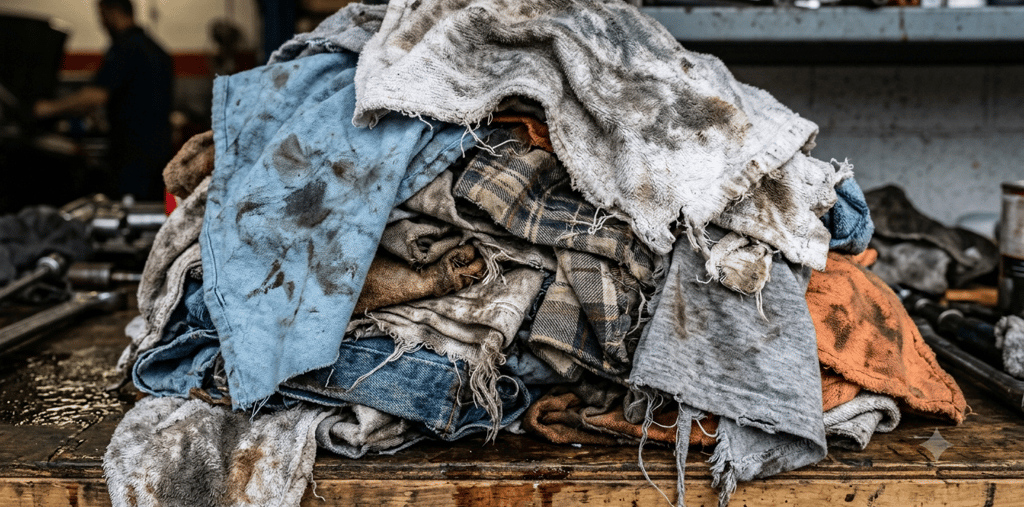

Knowing when a rag is spent isn't guesswork — the signs are usually visible up close.
How Often Should Workshop Rags Be Replaced?
If you run a workshop — whether it's a mechanical repair shop, a panel beating bay, a mining maintenance yard, or a manufacturing floor — rags are one of those unglamorous supplies you don't think about until you run out, or until a dirty, saturated rag causes a problem you didn't see coming. So how often should they actually be replaced? The honest answer is: it depends on how the rag is used, but there are clear signs and practical schedules that take the guesswork out of it.
Why Rag Condition Actually Matters
It's tempting to treat rags as disposable non-issues — grab one, wipe, toss it in the bin or the laundry bag, move on. But rag condition affects more than tidiness:
Contamination control — a rag saturated with oil, solvent, or coolant stops absorbing and starts smearing, which can recontaminate clean parts or surfaces.
Fire risk — oily rags left in a pile, especially natural-fibre ones, can undergo spontaneous combustion through oxidation heat build-up. This is a genuine workplace hazard, not an old wives' tale.
Surface damage — a rag that's picked up grit or metal filings can scratch paintwork, glass, or precision components on the next pass.
Compliance — many workshops operating under WHS or ISO-aligned quality systems are expected to demonstrate a documented consumables replacement process, rags included.
General Replacement Guidelines
There's no single number that applies to every workshop, but here's a practical framework based on how rags are typically used across mining, automotive, transport, and manufacturing settings.
1. Heavy-Duty Mechanical and Engine Work
Rags used for degreasing, engine bay wipe-downs, or handling heavy oils and grease should be assessed every shift. Once a rag can no longer absorb — it's stiff, saturated, or leaving streaks rather than lifting residue — it's done. In high-throughput bays this can mean multiple rags per technician per day.
2. General Wipe-Downs and Housekeeping
For lighter general-purpose cleaning — bench wipe-downs, spill mop-up, dusting — rags can usually be reused across a shift as long as they're still absorbent and free of embedded grit. Replace at the end of each shift or sooner if visibly loaded.
3. Precision and Panel Work
In panel beating, spray booths, or anywhere near painted or polished surfaces, the standard is stricter. A rag that has picked up any abrasive particles is a scratch risk. These should be swapped as soon as any grit contamination is suspected — don't wait for a scheduled changeover.
4. Chemical and Solvent Handling
Rags used with solvents, brake cleaner, or aggressive degreasers degrade faster and can become a chemical exposure risk themselves. Follow your SDS guidance for the specific chemical, but as a rule of thumb, treat these as single-use or very short-cycle rather than reusing across multiple tasks.
Warning Signs a Rag Needs Replacing — Regardless of Schedule
Time-based rules are a good baseline, but the rag itself will usually tell you when it's finished:
It's stiff, hardened, or crusted with dried residue
It no longer absorbs — liquid beads or smears instead of soaking in
It has visible metal filings, grit, or abrasive particles embedded in the weave
It smells strongly of solvent, fuel, or chemical off-gassing
It's torn, frayed, or shedding lint onto the surface being cleaned
It's been sitting saturated with oil in a bin or pile for an extended period (fire risk — deal with this immediately, not on a schedule)
Reusable vs Disposable: Does It Change the Answer?
Not really — it changes how replacement happens, not when. With a laundered rag service or reusable knitted wiper stock, "replacement" often means pulling the rag from active use and sending it to the wash rather than binning it outright. The same absorbency and contamination signs above still apply; a rag that's earned a trip to the laundry bag is one that's stopped doing its job effectively at the bench.
For single-use disposable wipes, the calculation is simpler — one wipe, one task, into the bin. This suits higher-risk chemical or contamination-sensitive work where cross-use isn't worth the risk.
A Simple Rule of Thumb
If you're not running a formal audit schedule, the safest general guideline for most industrial workshops is:
Assess rags at the start of every shift, and replace on the spot the moment one stops absorbing, shows contamination, or presents a fire risk — don't wait for it to fail completely.
Workshops that build this into a quick daily check (rather than an ad hoc "grab whatever's on the bench" approach) tend to see fewer contamination comebacks, cleaner finished work, and a lower fire risk from rag storage.
A quick daily check on rag condition costs seconds and saves rework.
Keeping Your Workshop Stocked
Running out of usable rags mid-shift is its own kind of costly — technicians end up improvising with whatever's nearby, which defeats the purpose of a proper wiping product in the first place. Keeping a steady supply of quality rags on hand, sized and sorted for the type of work you do, is the simplest way to avoid the problem altogether.
A well-stocked rag supply means no one's improvising with whatever's on the bench.
Have questions about which rag type suits your workshop's specific needs — T-shirt, Towel, coloured, or white? Get in touch and we can help match the right product to the job.