Save big on eco-friendly cleaning supplies

Cotton vs Microfibre: Which Cleaning Rag Is Right for You?
Which suits your workshop? A practical breakdown of absorbency, heat tolerance, cost, and finish for industrial use.
Perth Rag Supplies Technical Team
7/21/20263 min read
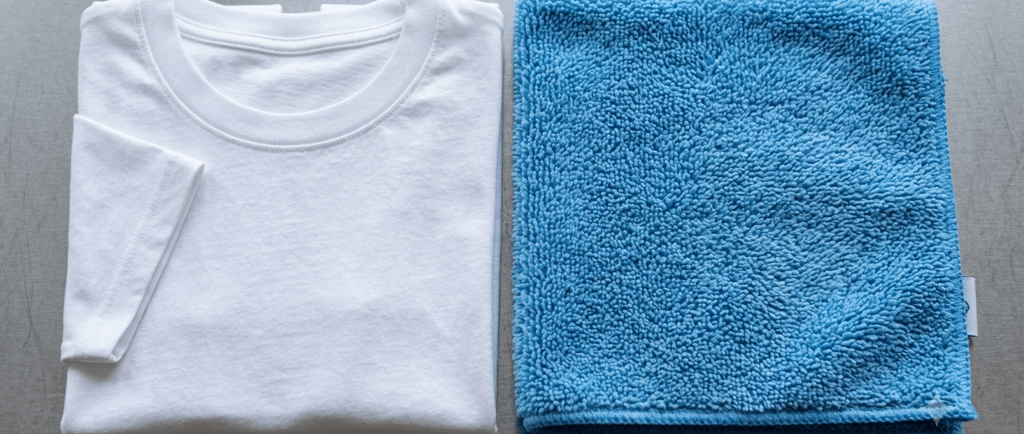
Same job, different fibre — and the fibre changes more than you'd expect.
Cotton vs Microfibre: Which Cleaning Rag Is Right for Your Workshop?
Cotton and microfibre are the two workhorse materials behind almost every wiping cloth in an industrial setting, and workshops often default to whichever one they've always used without weighing up whether it's actually the right fit. The two materials behave differently enough that the choice is worth a second look — especially if you're buying in bulk and want to get the most out of what you're stocking.
Cotton: The Case For It
1. Absorbency Under Heavy Load
Cotton is a natural fibre with excellent bulk absorbency — it soaks up oil, grease, coolant, and general liquid mess in high volumes before it's saturated. For heavy degreasing or engine work where you need a rag to hold a lot of liquid at once, cotton generally outperforms microfibre.
2. Heat and Solvent Tolerance
Cotton handles higher temperatures and a broader range of solvents without breaking down or melting. Anywhere a rag might contact a hot surface or aggressive chemical, cotton is the safer material.
3. Cost-Effective at Volume
Recycled cotton knit rags — often made from garment offcuts — are typically the most economical option for high-turnover, bulk consumption workshops. If you're burning through large quantities daily, cotton keeps the cost per rag down.
4. Lint
This is cotton's main drawback. It sheds lint, especially as it wears, which is a real problem anywhere lint contamination matters — precision assembly, optics, electronics, or pre-paint surface prep.
Microfibre: The Case For It
1. Superior Fine-Particle and Dust Pickup
Microfibre's split-fibre structure gives it a much larger effective surface area than cotton, which makes it far better at lifting fine dust, polishing residue, and micro-particles rather than just pushing them around. For glass, paintwork, and detailing-grade finishing, microfibre is the clear winner.
2. Streak-Free Finish
Because it doesn't shed lint and grips fine particles rather than smearing them, microfibre leaves a cleaner, streak-free result on glass, mirrors, screens, and polished panels — exactly where a cotton rag would leave fibres or streaking behind.
3. Reusable and Durable Through Washing
Quality microfibre holds up to repeated laundering far better than cotton without losing its structure, which suits workshops running a laundered reusable rag service rather than a disposable one.
4. The Trade-Off
Microfibre is less tolerant of high heat and can melt or glaze against hot surfaces. It's also generally more expensive per unit than recycled cotton, and it's not the best choice for absorbing large volumes of heavy oil or grease — it's built for fine finishing, not bulk mop-up.
A Simple Way to Decide
Heavy grease, oil, or degreasing work — Cotton
Hot surfaces or aggressive solvent contact — Cotton
High-volume, low-cost general wipe-down — Cotton
Glass, mirrors, screens, or polished panels — Microfibre
Fine dust or particle pickup, streak-free finish — Microfibre
Lint-sensitive precision or electronics work — Microfibre
Reusable rag program with frequent laundering — Microfibre
Can You Run Both?
Yes, and most well-stocked workshops do. Cotton earns its place as the everyday, bulk workhorse for the messy, high-volume side of the job, while microfibre gets reserved for finishing tasks where the result actually needs to look clean, not just be functional. Treating them as complementary stock rather than picking one over the other usually gets the best result for the least total cost.
Most workshops end up stocking both — cotton for the bulk work, microfibre for the finish.
Getting the Mix Right for Your Workshop
How much of each to stock comes down to what your workshop actually does — a detailing or panel shop will lean microfibre-heavy for finishing work, while a mining maintenance yard or general mechanical bay will lean cotton-heavy for volume and heat tolerance. Most operations land somewhere in between, with cotton as the daily bulk supply and microfibre kept on hand for the jobs where finish matters.
Not sure what mix of cotton and microfibre suits your workshop? Get in touch and we can help you work out the right stock split for your operation.