Save big on eco-friendly cleaning supplies
Reliable, absorbent, cotton-rich wiping cloths for workshops, mine sites and manufacturing floors across Australia.
If you're sourcing cleaning rags for a busy workshop, you already know the difference between a good batch and a bad one. Bad rags shed lint on painted surfaces, leave streaks on glass, or fall apart halfway through a wipe-down. Good rags — like our coloured t-shirt rag range — get the job done fast, hold up under solvents and grease, and don't cost you a second pass.
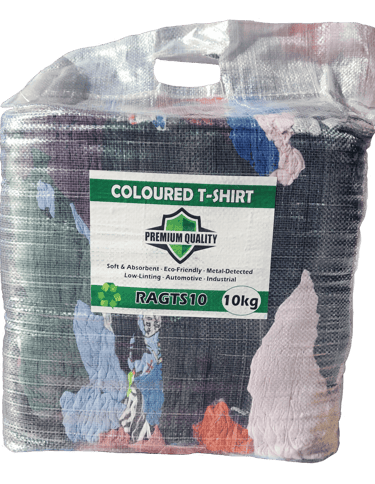
Coloured t-shirt rag is reclaimed knit cotton, cut from pre-worn t-shirts and sorted by colour rather than bleached back to white. It's one of the most popular grades we supply, and for good reason: it's soft, absorbent, low-lint, and priced well below new woven wipers — without the trade-offs you'd expect from a recycled product.
Coloured T-Shirt Cleaning Rags
What Is Coloured T-Shirt Rag, Exactly?
Coloured t-shirt rag is made from post-consumer knit cotton garments — mostly t-shirts, with some interlock and jersey blends — that have been collected, graded, and cut into workable rag sizes. Unlike white cotton rag, the colours aren't stripped out, which is what keeps the price down and the fabric intact (bleaching and reprocessing both add cost and can weaken fibres).
What you get is a soft, stretchy, highly absorbent wiping cloth that's excellent for:
Wiping down oil, grease and coolant on engines and machinery
General workshop clean-up and bench wipe-downs
Absorbing spills on concrete floors
Polishing and buffing where a slightly textured, non-scratch cloth is needed
Packing, padding, or dust covers where appearance doesn't matter
Because it's knit rather than woven, coloured t-shirt rag has natural stretch and won't fray at the edges the way a cut woven fabric can. It also tends to be more absorbent gram-for-gram than woven cotton, since knit construction holds liquid in the loops of the fabric rather than just on the surface.
Where it's less suited: if you need a completely lint-free finish (spray-painting prep, optical or electronics work), a woven or knitted-cotton white rag is usually the better call. We'll flag that further down.
Not sure if t-shirt rag suits your application? See our full industrial wiping cloth range for a side-by-side of every grade we stock.
Why Workshops and Mine Sites Choose Coloured T-Shirt Rag
Cost efficiency - Coloured rag sits at the more affordable end of the cotton rag spectrum because it skips the bleaching and re-dyeing process. For high-volume users — panel shops, transport depots, mine site workshops — that difference adds up fast over a year of ordering.
Absorbency - Knit cotton holds more liquid per kilogram than most woven fabrics, which means fewer rags used per job and less waste going into your bins.
Softness - T-shirt cotton is pre-washed and broken in, so it's gentler on painted and polished surfaces than stiffer woven offcuts — useful in automotive and panel beating work where scratching is a real cost risk.
Genuine recycled product - For businesses tracking their waste diversion or reporting on circular-economy sourcing, coloured t-shirt rag is a legitimate reused-textile product, not a marketing label.
Consistent supply - As a long-established rag supplier Australia businesses have relied on for over two decades, we grade and bale our rag domestically and through vetted overseas partners, so you're not stuck waiting on one erratic batch.
Compare this grade against our other stock in the cotton rag supplier price list to see where t-shirt rag fits your budget.
Coloured T-Shirt Rag vs Other Rag Grades
Not every job needs the same rag. Here's how coloured t-shirt rag stacks up against the other grades we're regularly asked about:
Grade Absorbency Lint level Cost Best for
Coloured t-shirt rag High Low–moderate $ General wipe-down, grease, spills, oily hands
White t-shirt rag High Low $$ Where colour transfer or dye bleed is a concern
Microfiber Extreme Very low $$$ Precision cleaning, glass, optics
Coloured towel rag Very High Low–moderate $$ Heavy-duty grease and coolant wipe-downs
White towel rag Very High Low–moderate $$ Heavy-duty grease or dye bleed is a concern
If your team is currently buying whatever's cheapest without matching the grade to the job, you're often paying twice — once for the rag, and again in labour when it takes three wipes instead of one, or when lint contaminates a paint job. A quick grading conversation with your supplier usually pays for itself within the first pallet.
Talk to us about matching grades to your specific application — see our product selection guide for the full breakdown.
How to Choose the Right Cleaning Rag for Your Application
We get asked this constantly, so here's the short version of how we advise customers:
What are you wiping up?
Oil and grease call for high-absorbency knit rags like coloured t-shirt rag. Solvents and thinners are better matched to a tighter woven cotton that won't dissolve as readily. Water and coolant spills work well with either.
Does surface finish matter?
If you're working on painted panels, polished metal, or anything where a scratch is expensive, go softer — t-shirt knit or a fine woven cotton. If it's a concrete floor or engine bay, durability matters more than softness.
Is lint a dealbreaker?
For spray booths, glass, and precision equipment, lint-free or low-lint white rag wins. For general mechanical work, a bit of lint is a non-issue.
What's your volume? High-turnover workshops (fleet maintenance, mine site workshops, panel shops) usually do best buying bulk cleaning rags by the 10kg or 20kg carton or pallet, rather than smaller retail packs — the per-kilogram price drops significantly at volume.
Compliance or reporting needs?
Some sites — particularly mining and heavy industrial — require documentation on rag composition (cotton content, colourfastness, absence of hazardous residue). We can supply spec sheets on request.
If you're stocking a workshop from scratch, our workshop consumables starter guide walks through what to order alongside your rag.
Buying in Bulk: What Procurement Teams Should Know
For wholesale cleaning rags, pricing typically breaks down by carton weight (usually 10kg or 15kg blocks) and by pallet volume for larger accounts. A few things worth knowing before you put in an order:
Ask for a sample carton first. Reputable suppliers will send one before you commit to a pallet order — grading can vary supplier to supplier, so it pays to check quality against your own benchmark.
Confirm the grading method. "Coloured t-shirt rag" should mean genuine t-shirt/knit cotton, not a mixed bag of synthetic-blend offcuts. Ask directly what percentage is cotton.
Check delivery lead times. If you're a mine site or regional workshop, freight time to your location matters as much as unit price — a cheaper rag that arrives three weeks late isn't actually cheaper.
Consider a standing order. Many of our workshop and transport clients set up recurring monthly or quarterly deliveries so rag stock never runs dry mid-job.
We supply account customers ranging from single-bay mechanic workshops to multi-site mining contractors, with pricing that scales properly at volume rather than token discounts on the second pallet.
Ready to set up an account? Jump to our bulk order and account setup section below.
Frequently Asked Questions
Is coloured t-shirt rag as good as white rag for cleaning? For most general workshop cleaning — grease, oil, coolant, general wipe-down — yes, it performs just as well and often better on absorbency. White rag mainly earns its higher price where lint-free or colour-neutral results matter, like spray painting prep or light-coloured surface work.
Will the dye or colour transfer onto my equipment or hands? Genuine pre-worn t-shirt cotton is fully colourfast from years of washing before it ever reaches the rag bin, so transfer isn't a practical issue in normal wiping use. It's a different story with unwashed off-cuts or poor-quality dyed fabric, which is one reason grading and sourcing matter.
What's the difference between rag and a shop towel or microfibre cloth? Shop towels and microfibre are manufactured specifically for cleaning and cost more accordingly. Cotton rag — including t-shirt rag — is a reused textile product, priced lower, and better suited to high-volume, lower-precision jobs like engine bays and floor spills rather than fine detailing.
Can I use coloured t-shirt rag with solvents and degreasers? Yes, it handles most standard workshop solvents and degreasers fine. For aggressive or high-heat chemical use, check compatibility first — we can advise based on the specific chemical you're using.
Do you supply Australia-wide? Yes. As an established industrial cloth supplier, we deliver to workshops, mine sites and manufacturers across WA and interstate, with freight options suited to metro and regional deliveries.
What's the minimum order for wholesale pricing? Wholesale pricing typically starts from a single carton, with better per-kilogram rates unlocked at pallet volume. Get in touch with your expected usage and we'll put together pricing that matches it.
Is this a sustainable or recycled product? Yes — coloured t-shirt rag is made from reclaimed textiles, making it a genuine option for businesses looking to reduce reliance on virgin materials and support textile reuse.
Get Your Wholesale Quote Today
Whether you're restocking a single workshop or setting up recurring supply for a multi-site operation, we'll get you a straightforward quote based on your actual usage — no inflated minimums, no guesswork on grading.
Talk to our team about:
Sample blocks before you commit
Volume pricing on 10kg, 15kg and pallet orders
Recurring account deliveries so you never run out
Matching rag grade to your specific application
Private label
Trusted by workshops, mining companies and manufacturers across Western Australia for over 20 years.