Save big on eco-friendly cleaning supplies

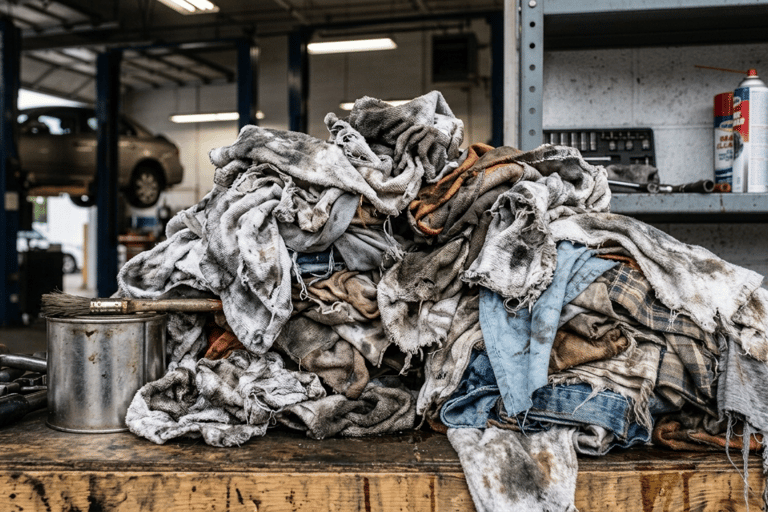
Ask most mechanics what's in reach on the bench, and it's a cotton rag.
Why cotton rags remain the mechanic's default — absorbency, heat tolerance, and durability for daily engine bay work.
Perth Rag Supplies Technical Team
7/21/20263 min read


Ask most mechanics what's in reach on the bench, and it's a cotton rag.
Why Mechanics Prefer Cotton Rags
Walk into almost any mechanical workshop — automotive, transport, heavy vehicle, or plant maintenance — and the rag on the bench or hanging off a technician's back pocket is, more often than not, cotton. It's not tradition for tradition's sake. Cotton earns its place in a mechanic's hands for a set of practical reasons that come straight from the nature of the work.
1. It Handles Heavy Oil and Grease Without Giving Up
Mechanical work means constant contact with engine oil, grease, coolant, and transmission fluid — often in large quantities at once. Cotton's natural fibre structure gives it strong bulk absorbency, soaking up a lot of liquid before it's saturated and stops being useful. A mechanic pulling a dipstick or draining a sump needs a rag that can take that volume without smearing it around instead of lifting it.
2. It Tolerates Heat
Engine bays run hot, and a rag is frequently used on or near surfaces that are still warm — manifolds, recently run components, freshly welded metal. Cotton holds up to heat far better than synthetic alternatives like microfibre, which can glaze or melt against a hot surface. For a mechanic who doesn't have time to wait for everything to cool before wiping it down, that heat tolerance matters.
3. Solvent Compatibility
Brake cleaner, degreaser, and various solvents are a daily part of mechanical work, and cotton stands up to a broader range of these chemicals without breaking down the way some synthetic fibres do. A rag that dissolves or disintegrates mid-task is worse than useless — it adds a mess rather than removing one.
4. It's Tough Enough for Rough Handling
Mechanical work is not gentle on tools or materials. Rags get balled up, stuffed into pockets, dragged across sharp edges and rough castings, and generally treated without much care. Cotton's fibre strength holds up to that kind of handling better than finer synthetic weaves, which tend to snag, tear, or degrade faster under rough conditions.
5. Cost Makes Sense at the Volume Mechanics Use
A busy workshop goes through a genuinely large number of rags per week, particularly recycled cotton knit rags made from garment offcuts. At that volume, cost per rag matters, and cotton is typically the more economical option compared to microfibre or specialty synthetic wipes — without giving up the absorbency the job actually needs.
6. It's a Known Quantity
There's also a simple familiarity factor. Cotton rags have been the standard in mechanical workshops for decades, and most technicians have a good instinctive sense of how a cotton rag will behave — how much it'll hold, how it wears, when it's done. That predictability counts for something on a busy shop floor where there isn't time to think twice about a consumable.
Absorbent, heat-tolerant, and cheap enough to go through in volume — cotton checks the boxes mechanical work actually needs.
Where Cotton Isn't the Right Call
None of this makes cotton universally superior — it's suited to the specific demands of mechanical work, not every task in a workshop. For fine finishing, glass, polished panels, or lint-sensitive precision work, microfibre generally does a better job. Most workshops that run a mix of mechanical and finishing work end up stocking both, using cotton for the heavy daily grind and microfibre where a cleaner finish is the goal.
The Bottom Line
Mechanics gravitate to cotton because it matches what the job actually demands — high absorbency, heat tolerance, solvent resistance, durability under rough handling, and a cost structure that works at the volume a busy bay goes through. It's less about habit and more about a fibre that's genuinely built for the conditions mechanical work throws at it.
Stocking up on cotton rags for your workshop? Get in touch and we can help you find the right grade and volume for your operation.